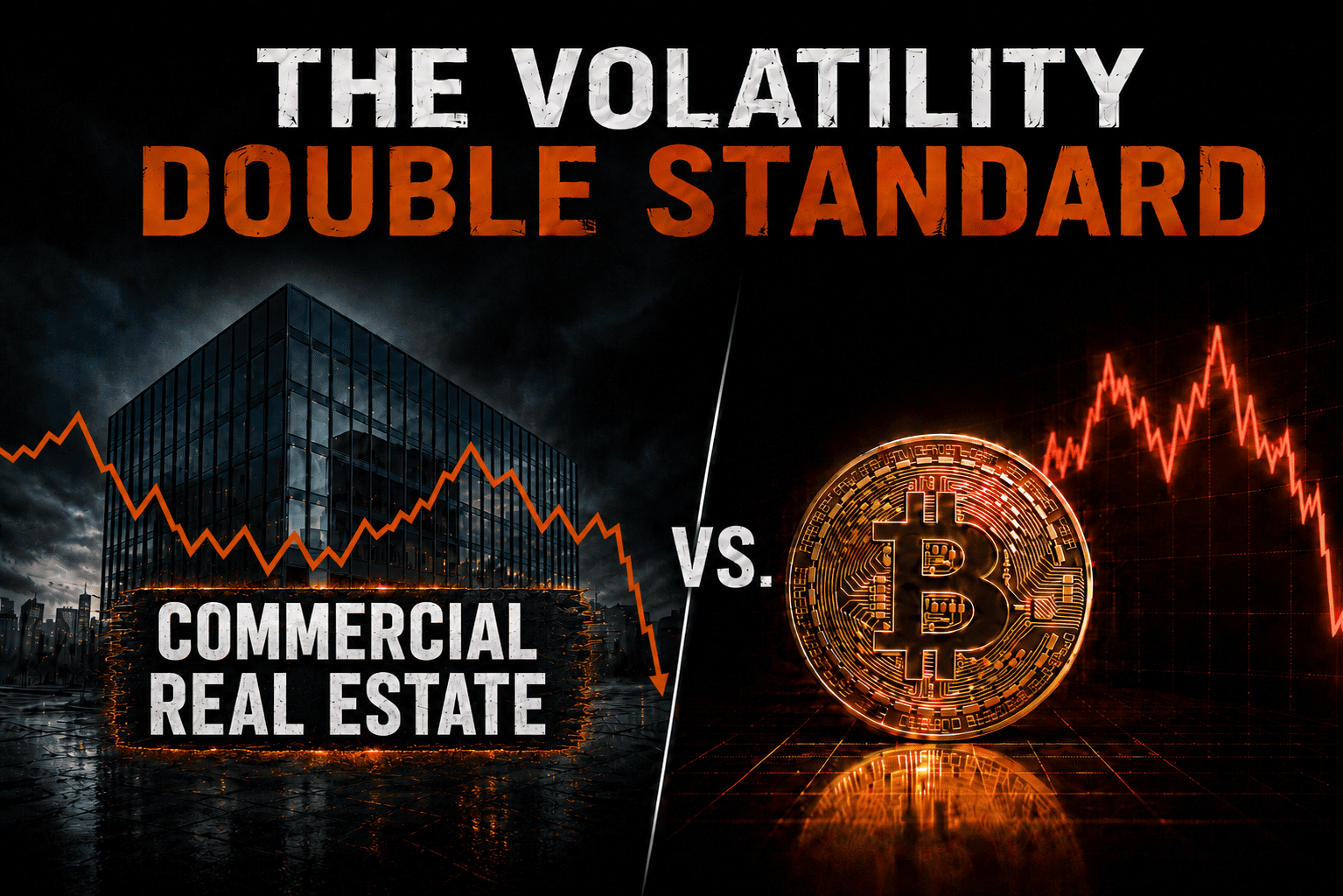
The Volatility Double Standard: Commercial Real Estate, Bitcoin and the Illusion of Stability
Commercial real estate owners often criticize Bitcoin for its volatility. In fact, volatility is one of the primary reasons many owners are unwilling to explore Bitcoin as a treasury asset, reserve strategy, or balance sheet tool within their real estate business.
The argument is familiar: Bitcoin moves too fast and can decline 50% or 60% from an all-time high. For many real estate investors, that level of price movement feels reckless, speculative, and fundamentally different from the stability they associate with income-producing property.
That argument confuses visible volatility with total volatility. Allow me to explain.
Commercial real estate is volatile, too. It simply expresses volatility differently.
Bitcoin’s volatility is immediate, visible, and emotionally uncomfortable. The price trades every second. The drawdown is public. The market tells you, in real time, exactly what someone is willing to pay.
Commercial real estate does not work that way. There is no live ticker for a two-tenant office building, a single-tenant industrial property, or a neighborhood retail center. Appraisals lag. Sale comps age quickly. Lenders reprice slowly. Owners can avoid marking their assets to market until a lease expiration, refinance, sale, or capital event forces the issue.
That delay creates the appearance of stability. But delayed price discovery is not the same thing as low volatility. In many cases, it simply means the volatility is buried inside the income stream, tenant roster, debt structure, and underwriting assumptions used to value the asset.
Real Estate Volatility Starts with the Tenant
The primary way commercial real estate owners manage volatility is through income. More specifically, they manage it through tenants. A building’s value is largely a function of its net operating income, the perceived durability of that income, and the market’s confidence that the income can be maintained or grown over time. When that income becomes uncertain, the value can change dramatically.
This is why owners prefer tenant diversification. A ten-tenant building can absorb one vacancy. A two-tenant building may not. If one tenant leaves a two-tenant property, the owner has not experienced a minor inconvenience. The owner may have just lost half of the property’s income. That can translate directly into a material valuation decline.
The same applies to single-tenant properties. A building leased to one tenant may feel stable while the lease is in place. It may even trade at a premium if the tenant is perceived as strong. But if that tenant fails, downsizes, relocates, or chooses not to renew, the asset can quickly shift from a “stable income property” to a vacant building with uncertain leasing prospects, significant capital needs, and impaired financing options. That is volatility. It may not show up daily. It may not show up on a screen. But economically, it is very real.
Long-Term Leases Are Not Always the Hedge Owners Think They Are
Traditionally, long-term leases have been one of the primary ways owners reduce volatility.
The logic is simple: longer lease term creates predictable income. Predictable income supports financing. Financing supports value. Value supports liquidity. That framework still matters but it is incomplete.
A long-term lease may reduce occupancy risk, but it can increase purchasing power risk. If rent escalations are fixed at 2% or 3% annually while insurance, taxes, utilities, labor, maintenance, debt costs, replacement costs, and monetary debasement are rising at a much higher rate, the owner may have locked in a cash flow stream that looks stable in nominal terms but deteriorates in real terms. That is a different kind of volatility. It is not the volatility of vacancy. It is the volatility of being trapped in an income stream that fails to keep pace with the true cost of ownership and capital preservation.
For decades, owners could rely on modest annual escalations, cap rate compression, declining interest rates, and broad asset inflation to offset that risk. That environment is no longer guaranteed.
The question is not simply, “How many years of term are left?”
The better question is, “Does this lease preserve real purchasing power, or does it only create the appearance of stability?”
Tenant Credit Needs to Be Re-Rated
The second major volatility hedge in commercial real estate has been tenant credit.
Owners, lenders, appraisers, and investors have long placed a premium on “credit tenants” or “A-credit tenants.” A lease backed by a large, established company has traditionally been treated as safer than a lease backed by a smaller private business. That assumption needs to be revisited. The pace of business disruption is accelerating, and artificial intelligence is a central reason why.
AI is not simply another software tool. It is beginning to challenge business models, reduce headcount needs, compress margins, automate workflows, and change how companies think about space. In some cases, it may make entire categories of labor, service delivery, and business infrastructure less relevant. In other cases, it may not eliminate a company, but it may materially reduce the company’s need for office space, support space, back-office operations, or even certain forms of industrial and retail occupancy. This risk is still greatly underappreciated.
Many people dismiss AI because it hallucinates, because they do not personally know how to use it, or because they assume the current version is representative of the final product. That is the wrong framework. Let’s not forget that today’s AI is the worst AI will ever be.
The technology is not improving at a linear pace. It is improving at an exponential pace and humans are generally poor at understanding exponential change because we tend to project the future in straight lines. That has major implications for tenant credit.
A company that looked dominant five years ago may be vulnerable today. A tenant that previously justified premium pricing may no longer deserve the same risk treatment. A SaaS company that once supported aggressive office valuations may now face AI-native competitors with lower headcount, lower costs, and better operating leverage. A legacy service business may see its margins compressed. A retail concept may be disrupted by AI-enabled personalization, logistics, and consumer behavior. Even industrial tenants may be affected by automation, robotics, reshoring strategies, inventory efficiency, and changing supply chain models.
I’m not saying that every incumbent tenant is weak. My point is that tenant credit is no longer static.
Commercial real estate has historically underwritten tenant credit as if large, established companies were inherently durable. In a world of AI-driven disruption, that assumption is dangerous because the largest incumbents may also have the most legacy overhead, the highest labor exposure, and the most to lose from AI-native competitors.
Tenant credit needs to be continuously re-rated and if tenant credit is re-rated, then lease value, cap rates, lender proceeds, residual values, and property pricing may need to be re-rated as well.
Real Estate Volatility Comes with Capital Requirements
There is another major distinction between Bitcoin volatility and real estate volatility.
When Bitcoin declines in price, the owner can do nothing. That may sound overly simple, but it is important. A Bitcoin holder does not need to contribute additional capital to repair the asset, re-lease the asset, pay commissions, fund tenant improvements, cover operating deficits, or convince a lender to remain patient. If the investor has conviction, proper custody, no forced leverage, and the right time horizon, they can simply hold while the network continues operating.
Real estate is different. When a building experiences volatility, the owner often has to spend money to recover. A vacancy does not just reduce income. It usually creates new capital requirements. The owner may need to fund marketing, tenant improvements, leasing commissions, free rent, building upgrades, legal costs and carry costs such as debt service, insurance, taxes, utilities, and maintenance while the space sits empty.
In other words, real estate volatility can hit twice. First, through the loss of income. Second, through the capital required to restore that income. That is a meaningful difference.
A vacant suite, a failed tenant, or a rollover event may create both a valuation problem and a liquidity problem. The owner may still believe in the long-term value of the asset, but belief alone does not fund tenant improvements or pay the lender. This is where real estate risk becomes more operationally complex than Bitcoin risk.
Bitcoin volatility tests conviction. Real estate volatility tests conviction, liquidity, operating capability, lender relationships, and access to capital.
Illiquidity Can Be a Feature
Real estate owners often view Bitcoin’s liquidity as an advantage in normal markets and a psychological liability during downturns. Bitcoin can be sold instantly. If it is sitting on an exchange or in a hot wallet, an investor can panic, click a few buttons, and exit the position at the worst possible time.
Real estate does not allow that kind of emotional reaction. Selling a building is slow, expensive, complicated, and uncertain. There are brokers, attorneys, lenders, inspections, title issues, due diligence periods, financing contingencies, buyer negotiations, and closing risk. The process creates friction.
In the context of volatility, that friction can be a feature, not a bug. It forces owners to pause. It gives them time to assess the situation. It incentivizes them to stabilize the asset. When a building loses a major tenant, experienced owners typically do not rush to sell into distress unless they are forced to. They work the problem and do everything they can to bring the asset back to a financeable and marketable position before making a major capital decision.
The same principle applies to Bitcoin. Investors with true conviction do not typically fire-sale during major drawdowns. If anything, many use those periods as accumulation opportunities. They understand the volatility, accept the time horizon, and remain focused on the long-term thesis.
This is why custody structure matters in Bitcoin. Cold storage, multi-signature custody, and disciplined treasury controls can create healthy friction. They make the asset harder to sell emotionally and easier to hold strategically. In that sense, proper Bitcoin custody can replicate one of real estate’s underrated advantages: it slows the investor down.
Volatility Requires Better Underwriting
The commercial real estate industry does not need to abandon its traditional risk management tools. Tenant diversification still matters. Lease term, credit, leverage, reserves and good locations all still matter. But, the industry needs to be more honest about what these tools actually protect against. They may reduce certain forms of volatility, but they do not eliminate volatility. And in some cases, they may hide it.
If owners measured performance against a more realistic inflation or debasement hurdle — for example, 10% to 12% per year — many properties would look far less stable than they appear under conventional underwriting.
A property growing NOI at 3% annually may look healthy in nominal terms. But if the real hurdle rate is materially higher, that asset may be losing economic ground each year. The owner may feel like they are preserving wealth while the property is quietly failing to maintain purchasing power. That is downside volatility. It is just hidden inside the unit of account.
Conclusion
Bitcoin should not be dismissed by commercial real estate owners simply because it is volatile. Real estate is volatile, too. The difference is that real estate volatility is slower, less visible, and often hidden inside lease structures, tenant credit assumptions, refinancing risk, capital requirements, and the unit of account.
The more important question is not whether an asset is volatile. The better question is whether the investor understands the nature of that volatility, has the conviction to hold through difficult periods, and has the right balance sheet, custody structure, and risk framework to avoid becoming a forced seller.
Commercial real estate owners already understand this principle. They live it every time they choose not to fire-sale a vacant building at the bottom of the market and instead work to stabilize the asset. Bitcoin requires the same discipline. Volatility is not the enemy. Misunderstood volatility is.